
Hiring your first salesperson is an important milestone.
You've built a business, developed customer relationships, and proven that people are willing to pay for what you sell. But you're still responsible for generating most of the new business. You can't continue finding every opportunity, conducting every sales conversation, and closing every important deal.
Before you start interviewing candidates, there's an important question worth answering: Is your business ready for that salesperson to succeed?
Hiring the right person is only part of the equation. The other part is creating an environment where that person has a reasonable opportunity to produce the results you expect.
Why Hiring a Good Salesperson Doesn't Guarantee Good Results
Imagine you've built a successful professional services business. Most customers have come through personal relationships, referrals, and your reputation. You understand their problems and know how to advance qualified opportunities. But much of that knowledge exists only in your head.
You hire an experienced salesperson, explain your services, introduce a few customers, give them access to your CRM, and send them off to sell. Three months later, they're not generating enough opportunities. You're still bringing in most of the new business.
Maybe you hired the wrong person. But consider another possibility: You hired someone to sell without giving them a clear understanding of how your business finds, qualifies, and wins customers.
The Cost of Hiring Before You're Ready
An unsuccessful sales hire can cost compensation, recruiting expenses, onboarding time, and opportunities that never materialize. It also consumes your time while you're still carrying much of the sales responsibility. If the hire doesn't work out, you may need to start again, without knowing whether the problem was the person or the environment.
The objective isn't to eliminate every hiring risk. It's to avoid preventable mistakes that make success unnecessarily difficult.
Hiring Readiness vs. Sales Readiness
Hiring readiness is about finding the right person: defining the role, compensation, candidate criteria, and evaluation process. Sales readiness is about creating the conditions for that person to succeed.
You don't need a sophisticated sales department before hiring your first salesperson. But you do need a foundation.
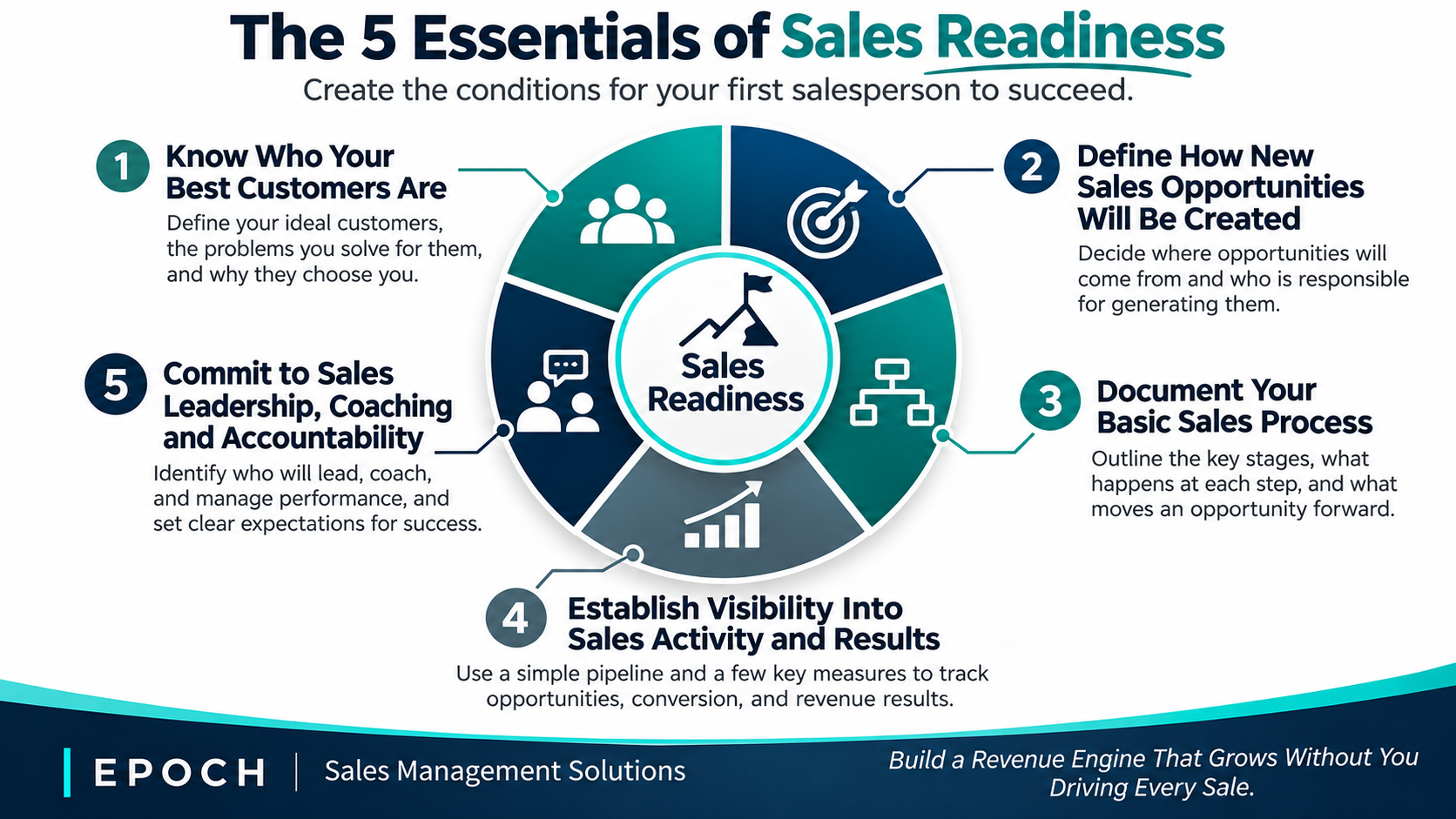
1. Know Who Your Best Customers Are
Your salesperson needs to know which customers your business is best equipped to serve. Look beyond labels like “small businesses.” Examine your best existing customers. What do they have in common? What problems were they experiencing? Why did they choose you? What makes them profitable and successful to serve?
Minimum requirement: Document your best-fit customers, the problems you solve for them, and why they choose your business. You don't need a sophisticated segmentation study, but you should provide a clear starting point for identifying promising prospects.
2. Define How New Sales Opportunities Will Be Created
Will you provide qualified leads? Will the salesperson generate their own opportunities? Or both? These are different responsibilities requiring different capabilities.
Someone who excels at converting qualified opportunities may not excel at initiating conversations with people who have never heard of your company. A successful account manager isn't automatically a strong new-business prospector.
Minimum requirement: Establish where opportunities will come from, who is responsible for generating them, and what prospecting activities are expected.
A salesperson should bring initiative, skills, and experience. Those qualities don't eliminate your responsibility to define what the business needs them to accomplish.
Ask: Where will this salesperson find people to sell to?
3. Document Your Basic Sales Process
As the owner, you've probably developed a way of selling that works, even if you don't call it a sales process. You know what questions to ask, when to recommend a solution, and how to recognize serious buying intent. Your salesperson needs access to that knowledge.
Start with the major steps: identify a potential customer; determine fit; conduct discovery; recommend an appropriate solution; gain agreement on next steps; finalize the sale and transition to delivery.
Minimum requirement: Define the major stages, what happens at each stage, and what qualifies an opportunity to move forward.
The objective isn't to turn your salesperson into a robot. It's to give them a proven starting point to learn, practice, and improve.
4. Establish Visibility Into Sales Activity and Results
Once you've hired, you need to understand how many qualified opportunities enter the pipeline, which are moving, where deals get stuck, and whether activity supports your revenue goals.
A CRM helps, but purchasing software doesn't automatically create visibility.
Minimum requirement: Establish a simple pipeline with defined stages, consistent opportunity updates, and a few meaningful measures.
Initially, focus on:
• Opportunity generation: Are we creating enough qualified opportunities?
• Sales effectiveness: Are we converting enough into customers?
• Revenue results: Are we generating the revenue expected?
Build more sophisticated dashboards later. Start with information that supports better decisions.
5. Commit to Sales Leadership, Coaching, and Accountability
Business owners often hire their first salesperson to spend less time selling. But hiring doesn't eliminate the owner's responsibility for sales leadership. Early on, it may increase it.
Someone must set expectations, train, review opportunities, coach skills, and hold the salesperson accountable. Initially, that may be you. You don't necessarily need a sales manager first, but someone must manage sales performance.
Minimum requirement: Identify who will lead the salesperson, establish regular coaching and pipeline-review meetings, and define what success should look like during the first 30, 60, and 90 days.
You don't need every answer, but you do need to make time for leadership.
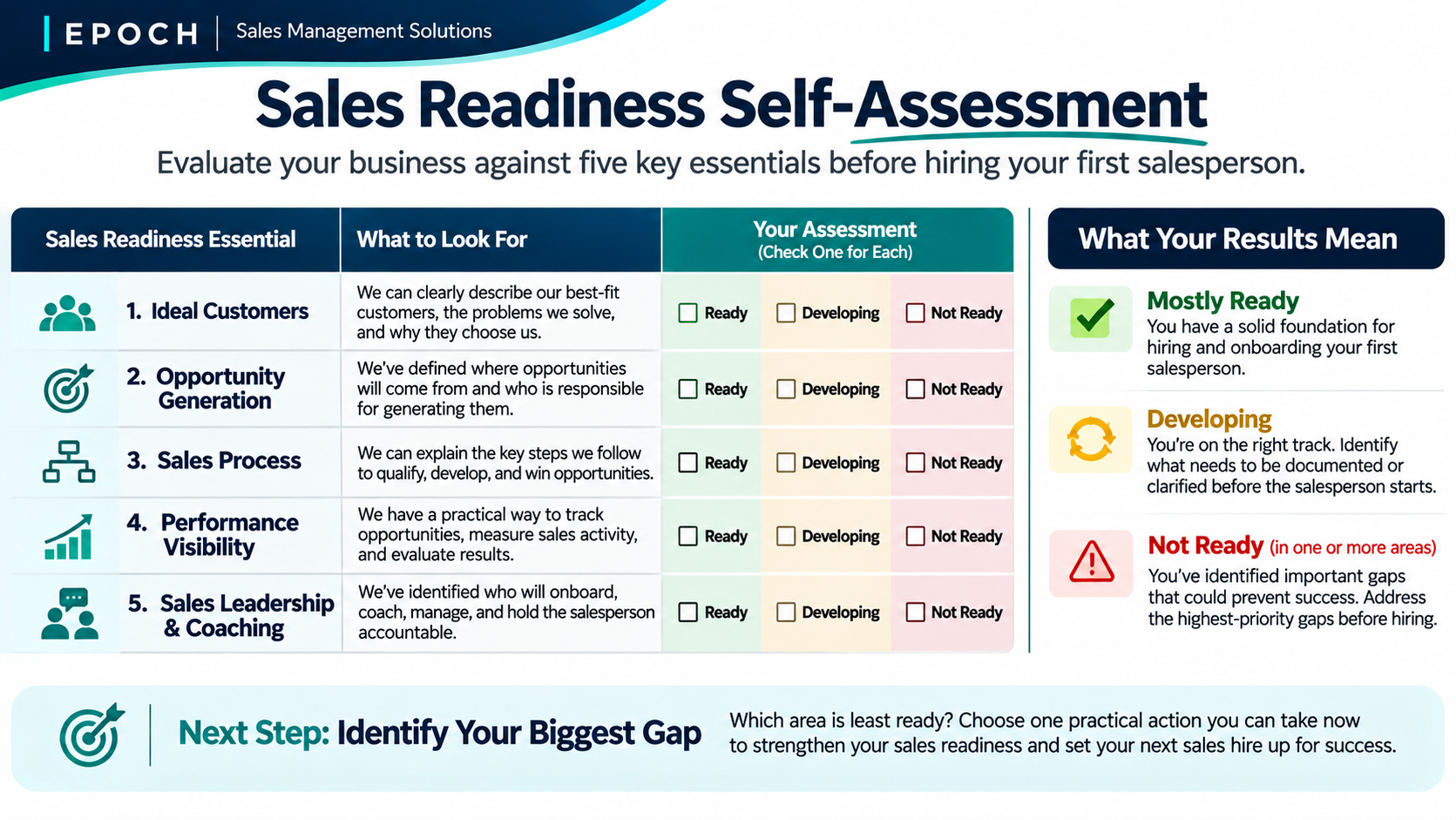
Sales Readiness Self-Assessment: Are You Ready to Hire?
For each essential, choose:
Ready — We have a defined approach someone other than the owner can understand and execute.
Developing — We have an approach, but it isn't fully documented or consistently followed.
Not Ready — We don't have a clear or consistent approach.
Assess these five statements:
1. We can describe our ideal customers and why they buy from us.
2. We've defined where opportunities come from and who generates them.
3. We can explain how we qualify, develop, and win opportunities.
4. We can track opportunities and evaluate performance.
5. We've identified who will onboard, coach, manage, and hold the salesperson accountable.
What Do Your Answers Tell You?
If all five are Ready, you have a useful foundation, though no guarantee of success. For Developing areas, identify what needs documenting or clarifying. For Not Ready areas, determine whether the gap could prevent the salesperson from fulfilling the role.
You don't necessarily need all five marked Ready before hiring. What matters is understanding the gaps, determining which could prevent success, and assigning responsibility and timing to close them. This isn't a pass-or-fail test; it's a tool for a better hiring decision.
What Should You Do If Your Business Isn't Ready?
Don't assume you need six months to build a complete sales organization. Review your last ten meaningful sales opportunities, or as many as you have available.
Which customers were the best fit? Where did opportunities originate? What questions established qualification? What moved deals forward? Why did you win some and lose others?
Use those experiences to document your approach. Then identify your most important gap and choose one improvement to make before your salesperson starts.
You don't need to solve every problem before hiring. But understand which problems you're asking the salesperson to help solve—and which remain your responsibility.
The Goal Isn't Just to Hire a Salesperson
The goal is to build a business that can grow without depending on you to drive every sale. That requires the right people, roles, processes, measures, and leadership.
Your first salesperson is an important step. The real transition happens when you turn what you've learned about selling into a repeatable system others can execute.
Ask yourself: Am I hiring someone to execute a sales process we've established—or expecting them to figure out how our business should sell?
Ready to Take the Next Step?
Complete the five-part Sales Readiness Self-Assessment. Identify your biggest gap and one action you can take.
EPOCH Sales Management Solutions helps business owners build sales teams and revenue systems that don't depend on the owner driving every sale.
Schedule a 30-Minute Discovery Conversation
Let's discuss where your business stands today and what needs to be in place for your next sales hire to succeed.